
by Susan Stamper •
Content Marketing Manager, ChiroHealthUSA •
I did not have “counting grams of protein” on my healthy-lifestyle bingo card, but here we are.
Some days, I feel as if I am studying for a nutrition exam I forgot to prepare for—reading labels and counting macronutrients like a mathematician who wandered into the grocery store. Eating healthy should be simple: eat real food, drink water, move your body and try not to treat a family-size bag as one serving. Right?
Apparently not.
After years of drive-through dinners and ultra-processed convenience foods being sold like little boxes of joy, it is no wonder our bodies—and tastebuds—sometimes do not know which way is up. Now protein has entered the chat, and it is not using its inside voice.
Protein cereal. Protein chips. Protein cookies. Protein water. Even peanut butter is getting a protein makeover, as if peanuts have been slacking all these years. I am half-expecting paper towels to announce 10 grams per roll.
As I continue my own healthy-lifestyle journey—because, honestly, “weight-loss journey” does not tell the whole story—I keep hearing the same chorus. Lifting weights? Protein. Cardio? Protein. Recovery? Protein. If protein had a publicist, that person deserves a raise.
Can we get enough from food that still looks like food? How much do we need? Do age and sex matter? And does every snack need a lab coat and a motivational quote?
Let’s dig in.
Protein Is Important—but It Is Not Magic Dust
Protein is made of amino acids that help build and repair muscle, skin, and other tissues. It also helps make enzymes and hormones and supports immune function. It is a dependable member of the crew: sensible shoes, lots of jobs.
What protein does not do is take a direct flight from your fork to your biceps.
Your body needs a reason to build and maintain muscle—usually resistance exercise, along with enough food, sleep and recovery. Research shows that eating more protein can create small additional gains in lean mass and certain measures of strength, especially when paired with resistance training (Nunes et al., 2022). Another analysis found that strength benefits increased as protein intake rose to about 1.5 grams per kilogram of body weight per day during strength training, but more protein beyond that point did not keep producing more gains (Tagawa et al., 2022).
Think of protein as the lumber and strength training as the construction crew. You can fill the driveway with two-by-fours, but they will not turn themselves into a house. Somebody still has to show up with a hammer.
Why Are the Numbers All Over the Place?
Ask three people how much protein you need, and you may get four answers, a calculator and somebody’s podcast.
The longstanding adult RDA is 0.8 grams per kilogram of body weight per day—about 55 grams for a 150-pound adult. It meets the needs of nearly all healthy people but was not designed specifically for muscle growth, weight loss or aging.
Then the 2025–2030 Dietary Guidelines for Americans arrived with a much higher general target: 1.2 to 1.6 grams per kilogram per day (U.S. Department of Health and Human Services & U.S. Department of Agriculture, 2026). For that same 150-pound person, that is roughly 82 to 109 grams.
That is not a tiny adjustment. That is the nutrition equivalent of someone moving the mailbox across the street and acting as if nothing happened.
Researchers are debating whether that range fits everyone because much of the evidence came from weight-management research, not every age and health group (Pasiakos et al., 2026). Nutrition research does love a plot twist.
A practical guide for adults is:
- Generally healthy and minimally active: about 0.8 to 1.0 grams per kilogram per day
- Regular recreational exercise: about 1.2 to 1.6 grams per kilogram per day
- Consistent resistance training: often about 1.4 to 1.6 grams per kilogram per day
- Healthy older adults: commonly about 1.0 to 1.2 grams per kilogram per day
To estimate your range, divide pounds by 2.2, then multiply by the target. If your brain quietly left the room, a physician or registered dietitian can help. Some people may need a goal or adjusted weight.
Men, Women and the “It Depends” Department
For most adults, protein needs are not dramatically different for men and women when calculated by weight. Men often need more total grams because they tend to be larger—not because they possess a secret protein compartment women were not issued.
Women move through life stages that change the conversation. The RDA rises to 1.1 grams per kilogram during pregnancy and 1.3 during lactation (Institute of Medicine, 2005). These are times for individualized advice, not free-pouring protein powder like Parmesan cheese.
During perimenopause and menopause, hormones may rearrange the furniture without asking. A 2026 analysis estimated that at least 1.2 grams per kilogram could support more favorable body composition in postmenopausal women, although it modeled a hypothetical intervention rather than testing one number in a clinical trial (Li et al., 2026).
The useful takeaway is simple: women in midlife should pay attention to protein, spread it through the day and pair it with muscle-strengthening activity. Aging men need to pay attention, too. Starting with more muscle does not come with a lifetime membership in the No Muscle Loss Club.
Age Makes Protein a Little More Particular
As we get older, muscles can become less responsive to smaller servings of protein. Researchers call this anabolic resistance. I think of it as the body becoming the customer with a very specific coffee order.
One study found that older men needed more protein per meal than younger men to maximize the short-term muscle-building response (Moore et al., 2015). Nobody needs a food scale in a holster, but breakfast deserves another look. It is often a protein ghost town—a piece of toast, coffee and good intentions.
A practical meal target may be roughly 20 to 30 grams for younger adults and 25 to 40 grams for older adults, depending on body size and health. Total daily intake matters most, but spreading it across meals is easier than trying to swallow half a chicken at 7 p.m.
And remember: protein brings the supplies. Movement sends the work order.
“Processed” Is Not One Big Bad Bucket
Plain Greek yogurt, tofu, canned beans and frozen edamame are processed for safety or convenience, but they still bring useful nutrients to the table.
Ultra-processed products often contain refined ingredients, sweeteners and additives most of us do not keep beside the salt. A 2024 umbrella review linked high intake with numerous health conditions. The evidence was largely observational, but the pattern is worth noticing (Dai et al., 2024).
My unofficial rule is to let most of my food still have a recognizable passport photo.
A protein bar on a travel day is not a character flaw. Convenience foods are tools. Trouble starts when the tool becomes the entire toolbox—and charges $4.99 per bar.
More Protein Without a Chicken Breast Following You Everywhere
The easiest approach is to ask: What is the protein anchor in this meal? Not the garnish. Not the three almonds rolling around at the bottom of the bowl. The anchor.
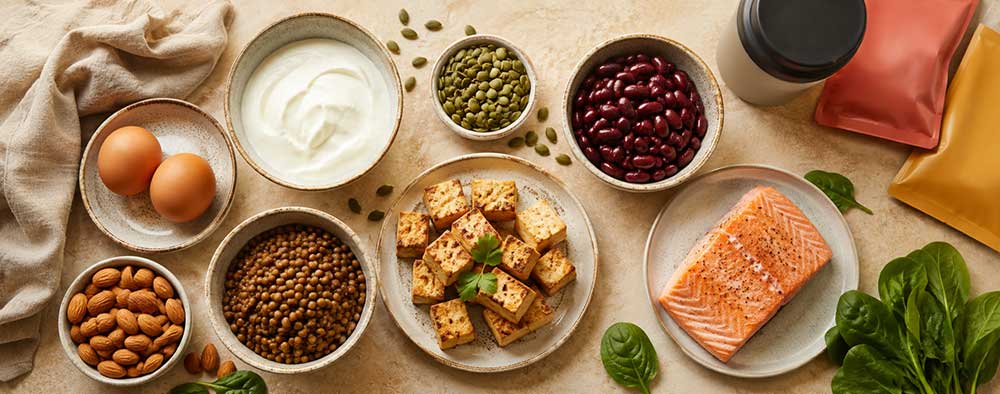
Approximate amounts include (U.S. Department of Agriculture, Agricultural Research Service, n.d.):
- Three to four ounces of chicken, turkey or fish: 22 to 30 grams
- One cup of cottage cheese: 24 to 28 grams
- Three-quarters to one cup of plain Greek yogurt: 15 to 22 grams
- One cup of cooked lentils: about 18 grams
- One cup of edamame: 17 to 18 grams
- One cup of cooked beans: 14 to 16 grams
- Three-quarters of a cup of firm tofu: 18 to 22 grams
- Two eggs: 12 to 13 grams
Then make those numbers behave like actual food:
Wake breakfast up. Add eggs, cottage cheese or plain Greek yogurt. Cook oatmeal with dairy or soy milk and toss in nuts or seeds. Breakfast does not have to be dessert wearing a cereal costume.
Let beans do some heavy lifting. Add lentils to soup, beans to salads and tacos, or mashed white beans to sauces. Beans show up in sensible shoes, bring protein and fiber, and do not demand their own advertising campaign.
Keep backup foods around. Canned fish, low-sodium beans, frozen edamame, boiled eggs and plain yogurt can turn “There is nothing to eat” into a meal in five minutes. That usually means, “Nothing is ready to jump into my hand.”
Invite plants to more meals. High-protein vegan diets can support muscle growth when protein and energy needs are met (Monteyne et al., 2023). Replacing processed meat with nuts, legumes and whole grains has also been associated with better long-term health (Neuenschwander et al., 2023).
“Eat more protein” should not become code for “put meat on everything that sits still.” Variety wins.
Put Protein Back on the Team—Not on a Throne
There is no trophy for the highest protein total. Once your body has what it needs, more has diminishing returns. An extreme focus on protein can also shove vegetables, fruit, whole grains and healthy fats off the plate like an enthusiastic aunt taking over the family photo.
The source matters. Processed meats and salty frozen meals are not the same nutritional package as beans, fish, yogurt, eggs, nuts, tofu or lean meat. A “PROTEIN” banner does not erase the rest of the label. That would be convenient, but so would pants that fold themselves.
Anyone with chronic kidney disease, significant liver disease or another condition requiring dietary management should speak with a physician or registered dietitian before increasing protein. Pregnant or lactating women, older adults with poor appetite and people taking medications that strongly suppress appetite also deserve individualized advice.
After sorting through the research, here is where I land: protein matters, but it does not need a cape, a fan club or an aisle of candy bars pretending to be health food.
Start with food you recognize. Find the protein anchor in your meals. Add strength-building movement that fits your ability. Remember the fiber, vegetables, fruit, hydration, sleep and all the other players waiting for their turn.
Healthy living is not a pass-or-fail exam. It is a collection of ordinary choices made often enough to matter. Your plate does not have to look perfect or impress a stranger on the internet. It simply needs to work for your body, your life and the future you are trying to build. 💪🥗
And if anyone tries to sell us protein-enhanced lettuce, we may need to call a meeting.
This article is for general educational purposes and is not a substitute for individualized medical or nutrition advice.
Sources
Dai, S., Wellens, J., Yang, N., Li, D., Wang, J., Wang, L., Yuan, S., He, Y., Song, P., Munger, R., Potvin Kent, M., MacFarlane, A. J., Mullie, P., Duthie, S., Little, J., Theodoratou, E., & Li, X. (2024). Ultra-processed foods and human health: An umbrella review and updated meta-analyses of observational evidence. Clinical Nutrition, 43(6), 1386–1394. https://doi.org/10.1016/j.clnu.2024.04.016
Institute of Medicine. (2005). Dietary reference intakes for energy, carbohydrate, fiber, fat, fatty acids, cholesterol, protein, and amino acids. The National Academies Press. https://doi.org/10.17226/10490
Li, J., Jiang, L., Saquib, N., Gradidge, P. J.-L., Liu, S., Van Horn, L., Richey, P. A., Timberlake, D. S., Beydoun, H. A., Liu, L., Li, J., & Odegaard, A. O. (2026). Estimating the effect of hypothetical dietary protein interventions on changes in body composition of postmenopausal women over 3 years using data from the Women’s Health Initiative Study: An emulated target trial. International Journal of Obesity, 50(3), 609–617. https://doi.org/10.1038/s41366-025-01978-0
Monteyne, A. J., Coelho, M. O. C., Murton, A. J., Abdelrahman, D. R., Blackwell, J. R., Koscien, C. P., Knapp, K. M., Fulford, J., Finnigan, T. J. A., Dirks, M. L., Stephens, F. B., & Wall, B. T. (2023). Vegan and omnivorous high-protein diets support comparable daily myofibrillar protein synthesis rates and skeletal muscle hypertrophy in young adults. The Journal of Nutrition, 153(6), 1680–1695. https://doi.org/10.1016/j.tjnut.2023.02.023
Moore, D. R., Churchward-Venne, T. A., Witard, O., Breen, L., Burd, N. A., Tipton, K. D., & Phillips, S. M. (2015). Protein ingestion to stimulate myofibrillar protein synthesis requires greater relative protein intakes in healthy older versus younger men. The Journals of Gerontology: Series A, 70(1), 57–62. https://doi.org/10.1093/gerona/glu103
Neuenschwander, M., Stadelmaier, J., Eble, J., Grummich, K., Szczerba, E., Kiesswetter, E., Schlesinger, S., & Schwingshackl, L. (2023). Substitution of animal-based with plant-based foods on cardiometabolic health and all-cause mortality: A systematic review and meta-analysis of prospective studies. BMC Medicine, 21, 404. https://doi.org/10.1186/s12916-023-03093-1
Nunes, E. A., Colenso-Semple, L., McKellar, S. R., Yau, T., Ali, M. U., Fitzpatrick-Lewis, D., Sherifali, D., Gaudichon, C., Tomé, D., Atherton, P. J., Camprubi Robles, M., Naranjo-Modad, S., Braun, M., Landi, F., & Phillips, S. M. (2022). Systematic review and meta-analysis of protein intake to support muscle mass and function in healthy adults. Journal of Cachexia, Sarcopenia and Muscle, 13(2), 795–810. https://doi.org/10.1002/jcsm.12922
Pasiakos, S. M., Davis, T. A., Klurfeld, D. M., Neuhouser, M. L., Rodriguez, N. R., & Tomé, D. (2026). Perspectives on the protein recommendations in the 2025–2030 Dietary Guidelines for Americans. The Journal of Nutrition, 101754. https://doi.org/10.1016/j.tjnut.2026.101754
Tagawa, R., Watanabe, D., Ito, K., Otsuyama, T., Nakayama, K., Sanbongi, C., & Miyachi, M. (2022). Synergistic effect of increased total protein intake and strength training on muscle strength: A dose-response meta-analysis of randomized controlled trials. Sports Medicine – Open, 8, 110. https://doi.org/10.1186/s40798-022-00508-w
U.S. Department of Agriculture, Agricultural Research Service. (n.d.). FoodData Central. Retrieved August 10, 2026, from https://fdc.nal.usda.gov/
U.S. Department of Health and Human Services, & U.S. Department of Agriculture. (2026). Dietary Guidelines for Americans, 2025–2030. https://cdn.realfood.gov/DGA_508.pdf